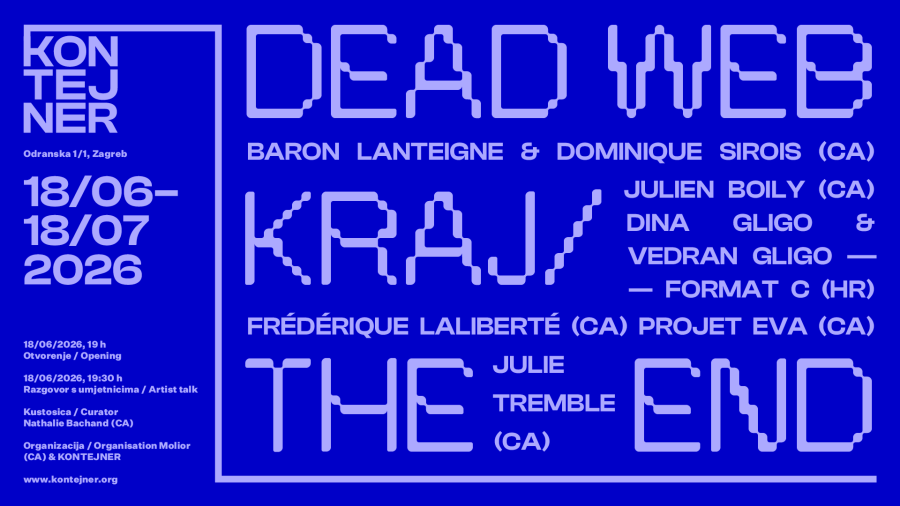
BARON LANTEIGNE & DOMINIQUE SIROIS (QC-CA) / JULIEN BOILY (QC-CA) / DINA GLIGO & VEDRAN GLIGO – FORMAT C (HR) / PROJET EVA (SIMON LAROCHE & ETIENNE GRENIER) (QC-CA) / FRÉDÉRIQUE LALIBERTÉ (QC-CA) JULIE TREMBLE (QC-CA)
Présentée à KONTEJNER, à Zagreb en Croatie, du 18 juin au 18 juillet 2026.
Information à propos des oeuvres >>
Cette exposition a été présentée pour la première fois en 2017. Presque dix ans plus tard, le visage d’Internet a considérablement changé. Notamment, la présence de l’intelligence artificielle (IA) s’y est intensifiée : en 2024, les bots y ont dépassé l’activité humaine; l’IA générative contribue activement à la désinformation; et l’algorithme publicitaire est insistant, voire harcelant. La promesse d’émancipation qu’a déjà représentée Internet s’apparente dorénavant à un asservissement plus ou moins volontaire, et le souhait de s’éloigner de l’écran connecté est presque proportionnel à notre obligation quasi quotidienne de l’utiliser. Cette phrase « Comment le courriel m’a trouvé », et les images associées – disséminées à travers de multiples mèmes –, résument bien notre rapport actuel à la culture Internet et à l’accablante hyperconnexion qui en résulte. Et si, un jour, ces courriels cessaient de nous trouver… ?
–
Tout a commencé en mai 2015 lorsque parut sur lemonde.fr un article qui suggérait la possibilité d’un effondrement du Web. Bien que cet évènement soit hautement hypothétique, plusieurs articles ont été écrits sur le sujet en réaction à un symposium scientifique organisé par la Royal Society sur la capacity crunch (crise de capacité) d’Internet.
Dans un contexte où le réseau pourrait s’effondrer abruptement, nous pouvons tenter de se figurer la chute et une forme d’après-monde du Web : carcasses vides de serveurs et mers de déchets électroniques ? Néant numérique des écrans ? Machines imitant le Web ? Internet artisanal ? Quelle forme l’expression, à la fois dématérialisée et délocalisée, du pouvoir – économique assurément et par défaut politique – prendrait-elle si la machine se trouvait débranchée ? Mais aussi, qu’est-il possible de faire ou de dire en attendant ? Comment occupe-t-on – ou non – un temps et un espace dits de sursis, un espace-temps désormais partagé entre les réalités numériques et physiques ?
Dans le sillage de ces réflexions, des propositions artistiques qui rencontrent une résonance autour de tels questionnements ont été rassemblées. Initialement composée d’artistes du Québec, cette exposition accueille également, pour l’occasion, un duo d’artistes croates. Ensemble, ces œuvres apportent une perspective particulière, qui construit et défait tout à la fois notre idée du Web et de son absence.
–
« The Dead Web – La fin a été présentée pour la première fois en janvier et février 2017 au centre d’artistes Eastern Bloc à Montréal. À la suite de cette première itération indépendante, l’exposition a été produite par Molior et présentée au Festival Mirage à Lyon en France en avril 2019, puis au Mapping Festival à Genève en Suisse en mai et juin 2019, et finalement au Ludwig Museum – Museum of Contemporary Art à Budapest en Hongrie de janvier à avril 2020. »
« Les œuvres de cette exposition interrogent notre relation à Internet et, plus largement, à la notion de connexion comme point de contact avec la réalité. Cette exposition propose au public un monde post-Internet. Dans cette nouvelle itération présentée à KONTEJNER, deux oeuvres se sont ajoutées : Pivilion/EXEno1: TOGETHERTOGETHER des artistes croates Dina Gligo et Vedran Gligo (Format C) et Infinitisme.com: FINAL NOTICE de Frédérique Laliberté. Cette dernière installation sculpturale et sonore a été créée spécialement pour l’exposition à partir des résidus matériels et virtuels de l’œuvre Infinitisme.com Forever A Prototype, qui était présentée dans les éditions précédentes. »
« Cette exposition est rendue possible grâce aux soutiens du Conseil des Arts du Canada et du Conseil des Arts et des Lettres du Québec. »
« Nous tenons également à remercier la Ville de Zagreb, le Ministère de la Culture et des Médias de la République de Croatie, la Fondation Kultura nova et la Fondation nationale pour le développement de la société civile pour leur support. »
–
BARON LANTEIGNE & DOMINIQUE SIROIS (QC-CA) / JULIEN BOILY (QC-CA) / DINA GLIGO & VEDRAN GLIGO – FORMAT C (HR) / PROJET EVA (SIMON LAROCHE & ETIENNE GRENIER) (QC-CA) / FRÉDÉRIQUE LALIBERTÉ (QC-CA) JULIE TREMBLE (QC-CA)
Presented at KONTEJNER, Zagreb in Croatie, from June 18 to July 18, 2026.
Information about the artworks >>
This exhibition was first presented in 2017. Nearly ten years later, the face of the Internet has changed considerably. The presence of artificial intelligence (AI), in particular, has intensified: by 2024, bots had surpassed human activity online; generative AI actively contributes to misinformation; and advertising algorithms are persistent, even harassing. The promise of liberation that the Internet once held now resembles a form of more or less voluntary enslavement, and our desire to step away from the connected screen is almost proportional to our near-daily obligation to use it. This sentence “How the email found me,” and the accompanying images—which have spread through countless memes—aptly sum up our current relationship with Internet culture and the overwhelming hyperconnectivity that comes with it. What if, someday, these emails stopped finding their way to us…?
–
It all began in May 2015, when an article on lemonde.fr suggested the possibility of a collapse of the World Wide Web. Although this event is largely hypothetical, several articles have been written on the subject in response to a scientific symposium that the Royal Society organized around the Internet Capacity Crunch.
In a context where the network could abruptly collapse, we can try to picture the fall of the Web and the afterworld that would ensue: Empty server carcasses and a sea of electronic junk? A digital oblivion on all screens? Machines imitating the Web? A handcrafted Internet? How will the at once dematerialized and delocalized dynamics of power structures be impacted in both their evident economic and inevitably political manifestations if the network is disconnected? But also, what can still be said or done in the meantime? How does one occupy—or not—what is essentially borrowed time and space, a space-time henceforth to be shared between digital and physical realities?
In the wake of these reflections, artistic proposals that echo these considerations have been gathered. Originally featuring artists from Quebec, this exhibition also includes, for this occasion, a duo of Croatian artists. Altogether, these artworks offer a particular perspective, building and unpacking our idea of the Web, and its absence, at the same time.
–
« The Dead Web – The End was presented for the first time at the Eastern Bloc artist-run center in Montreal in January-February 2017. After this first independent iteration, the exhibition was produced by Molior and shown at the Mirage Festival in Lyon (France) in April 2019, and then at the Mapping Festival in Geneva (Switzerland) in May-June 2019, and finally at the Ludwig Museum – Museum of Contemporary Art in Budapest (Hungary) in January-April 2020. »
« The works in the exhibition question our relationship to the Internet and, more broadly, the notion of connection as a point of contact with the world. The exhibition is trying to engage the audience in presenting the post-internet world. In this new presentation at KONTEJNER, two works have been added: Pivilion/EXEno1: TOGETHERTOGETHER by Croatian artists Dina Gligo and Vedran Gligo (Format C), and Infinitisme.com: FINAL NOTICE by Frédérique Laliberté, a sculptural and sound installation created especially for the show from the material and virtual debris of Infinitisme.com Forever A Prototype, that was presented in previous editions of the exhibition. »
« This exhibition is made possible thanks to the support of the Canada Council for the Arts and the Conseil des Arts et des Lettres du Québec. »
« We would also like to thank the City of Zagreb, the Ministry of Culture and Media of the Republic of Croatia, the Kultura nova Foundation and the National Foundation for Civil Society Development for their support. »
Catégories :Commissariat / Curating

 NATHALIE BACHAND
Commentaires récents